How Pokémon Legends:Arceus changes the 26-year-old Pokémon formula
05 Jun 2022
Since 1996 the mainline Pokémon series chose to stick with what worked and did not pursue change. Is innovation needed if the 26-year-old formula works every time? Why take the risk if every release is making a huge profit already?
In 2022, Game Freak decided to take that leap of faith with the release of Pokémon Legends: Arceus, their first title in the action role-playing genre, with surprising new changes to their well-established formula.
What changed within the Pokémon formula?
Story & Depth
The story of previous titles followed a particular and concrete narrative structure:
- A teenager protagonist leaves their hometown with the goal of becoming the greatest Pokémon master.
- The said teenager battles Gym Leaders and a group of Elite trainers while also fighting whatever criminal organization resides in the region.
- The protagonist reforms or stops the criminal organization and also becomes the ultimate Pokémon master.
There is nothing wrong with the proven “Heroic Pokémon Master” route. However, since it is overused, it becomes incredibly predictable with each Pokémon game.
PLA (Pokémon Legends: Arceus) ultimately rejects the clichéd narrative structure. Players start as a 15-year-old teenager with amnesia who somehow time-travels through a cosmic rift to an old region called Hisui.
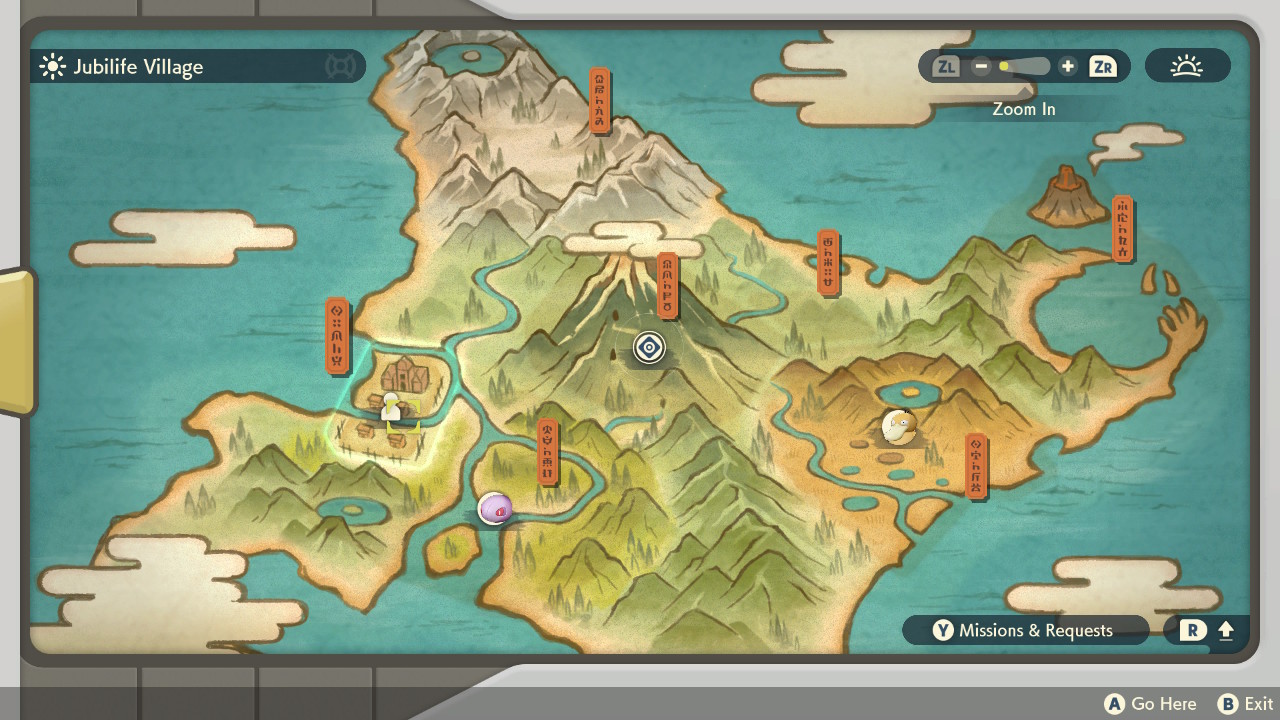
Map of Hisui.
Hisui resembles a fictional ancient Japan. People of Hisui are strangers to Pokémon and are often afraid to engage with them. Luckily, our protagonist is somewhat knowledgeable about Pokémon, which piques the local scientist’s interest in the nearby village. The protagonist quickly joins the village’s Survey Corps to investigate the space-time rift for a way back and help the people of Hisui, by catching Pokémon and filling up the local Pokémon encyclopedia. A refreshing change to the “glory seeker” narrative of the old.
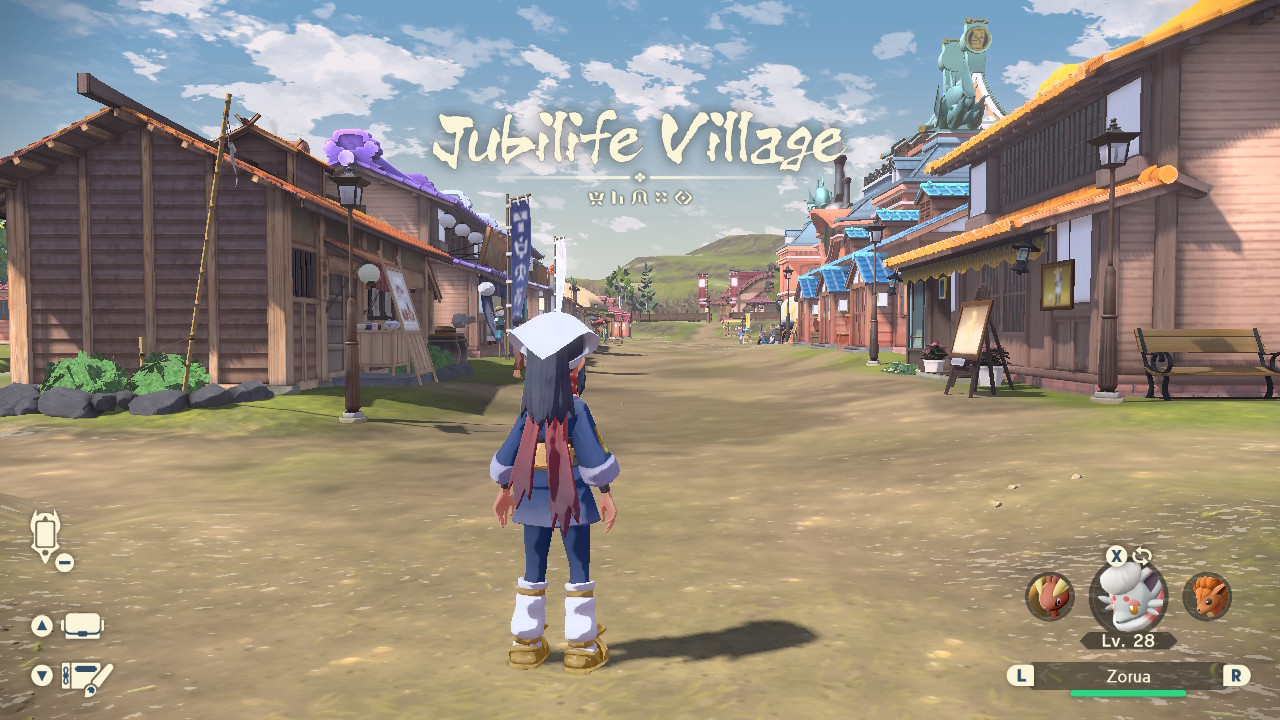
Largest human settlement within Hisui.
The classic “Gym Leader Pokémon vs. Players’ Pokémon” is also no more. Players need to fight and tranquilize five frenzied Noble Pokémon, initially believed to be blessed by the Pokémon God.
Instead of a rebellious criminal organization seeking chaos, PLA introduces Galaxy Expedition Team, Diamond, and Pearl clans. They occasionally become an obstacle for the player with their own unique political and religious agendas. In contrast to previous games, it is slightly less “Good vs. Evil” and with more grey areas.
Overall with PLA, a Pokémon story finally gains some depth. In addition to the classic search of Pokémon, it offers a chance to explore the culture and politics of humans within that same universe.
New Battle Mechanics
Styles
The previous games introduced temporary Pokémon transformations such as Mega Evolution, Dynamax, and Gigamax that were usable during battle. These transformations granted increased stats and a new single powerful move with secondary effects. They were good additions to the game and added some depth to battles. However, they were a bit too straightforward, with several restrictions that made them feel slightly rigid.
In PLA, any Pokémon can Master its moves by leveling up. At the cost of an additional PP (Power Point: Energy required to perform a move), players can order a Pokémon to perform a mastered move in one of the two additional styles: Agile and Strong.
Moves performed with the Strong style have increased power, effect, and accuracy but delay the user’s next turn in battle.
Agile style can increase the user’s amount of turns at the cost of some power and accuracy.
Almost all moves can be mastered; this creates many strategies to explore. A lot more flexible than what transformations have offered in previous games.
The correct usage of Styles plays an essential role in PLA due to how the game handles turn priority with a new system called Action Order.
Turns & Actions
The speed stat always determined which Pokémon would act first in a turn. However, in PLA, moves are not executed in the same turn; instead, each Pokémon performs moves in its own turn.
Action Order makes it possible to see which Pokémon will be able to act for the next several turns. If the speed of a Pokémon is far greater than the other, it may even get a double-turn. Speed plays a far more critical role than before.
Each Pokémon has an Action Time based on its speed stat in this new system. When the Action Time of a Pokémon reaches zero, it gets its turn.
Performing a move in the Strong style adds to the user’s action time for its next turn. It essentially slows the user down. It can give the enemy a double-turn and leave the user vulnerable.
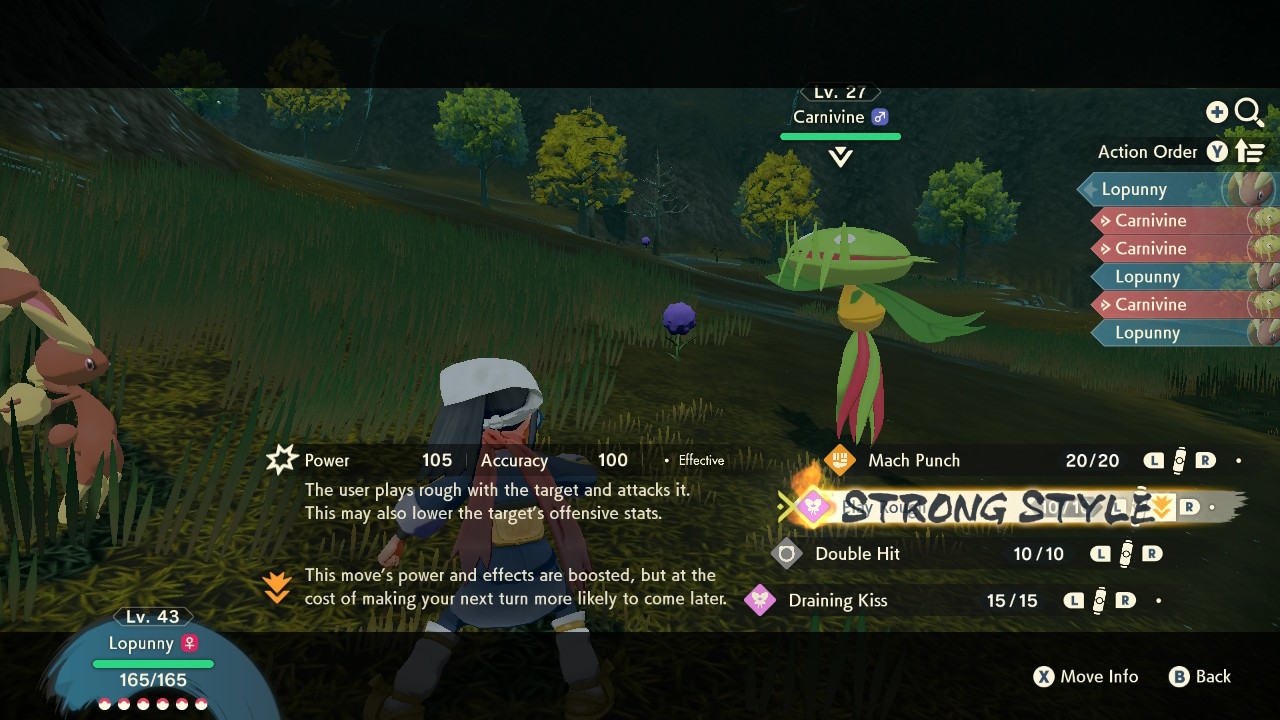
After selecting the Strong Style, Action Order shows that enemy Carnivine will act back to back.
An agile move targeting an enemy adds to the target’s action time, slowing the enemy so the user may get a turn sooner or even a double-turn.
However, if the Agile style targets the user itself, it will just subtract from the user’s action time to act sooner.
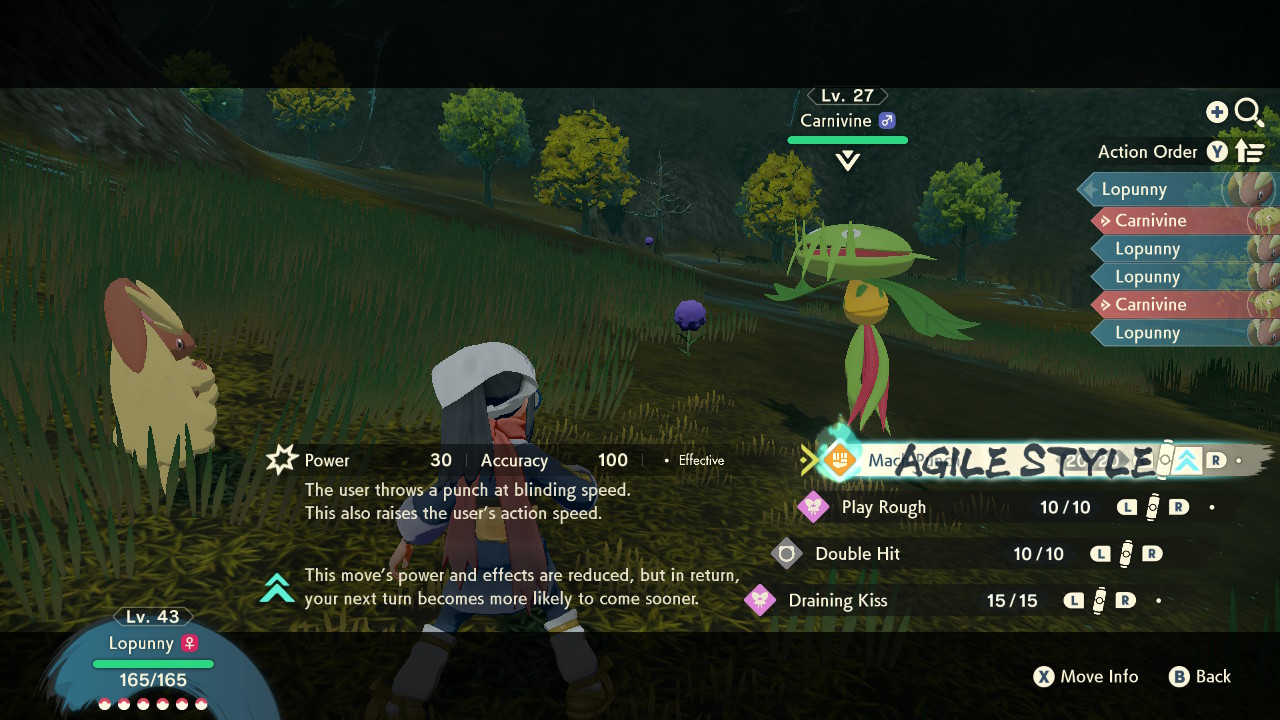
After selecting the Agile Style, Action Order shows that Lopunny will get to act two times in a row.
This difference ensures that the Agile style does not slow down multiple targets and become too powerful. Also, consecutive use of agile moves decreases the amount of time it adds or subtracts to make certain players do not overuse it.
Styles can help perform combos, 1-hit KOs, switching to other Pokémon, and increasing the duration of buffs or debuffs. It adds another layer of strategy to battles. It makes it possible to explore many different combinations of attacks and Pokémon.
Noble Pokémon Fight
Noble fights are compromised of two phases: action and turn-based. In the action phase, players will need to memorize enemy attack patterns and dodge & roll at the right moment. Like Dark Souls, without the one-hit game-overs. Players also need to throw special balms at the Noble to decrease its hit points.
Eventually, Nobles will leave an opening for the player to send in a Pokémon to initiate a turn-based battle. After some damage is dealt to the Noble, the fight will loop back to the action phase until either party faints.
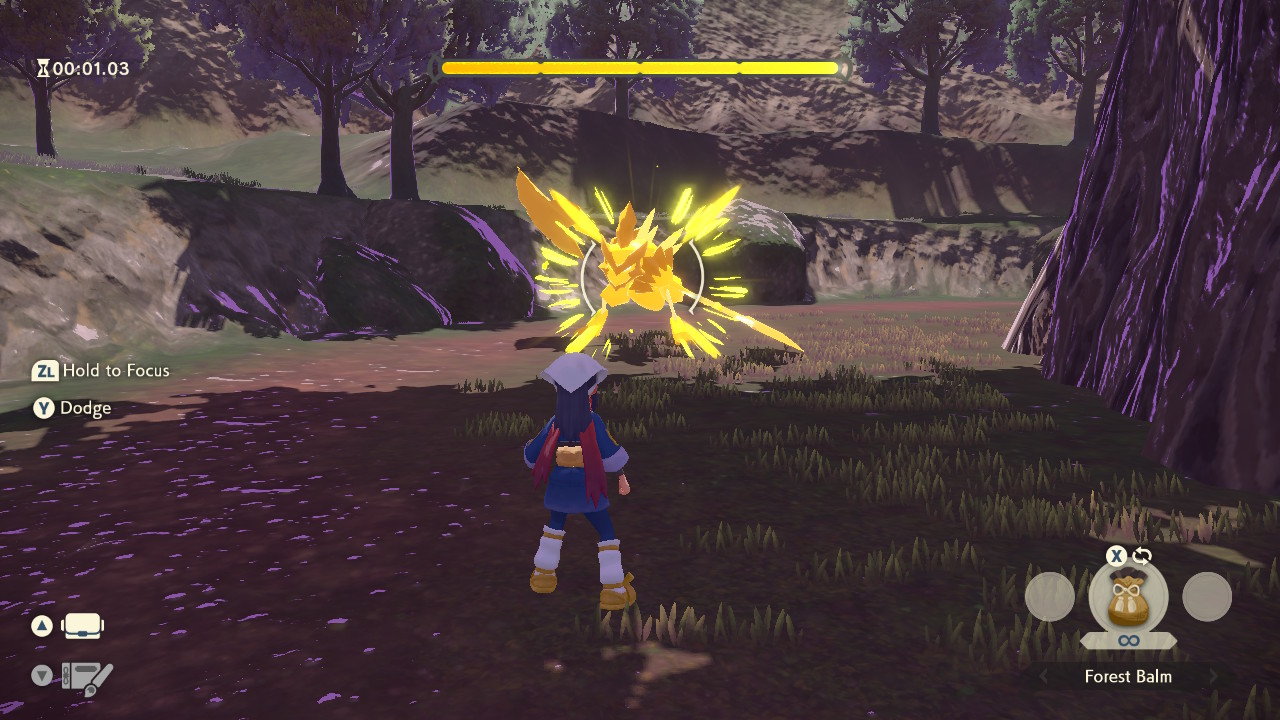
A Noble charging at the player.
Noble fights have a delicate balance between action & strategy. A far more interesting boss fight than a Gym Leader sending out highly predictable enemies fit for that gym’s type.
Simpler Grind
Shared EXP
EXP (Experience Point) share between Pokémon within the active party was optional in previous titles. It was possible through items that Pokémon could equip. The system was flexible and increased the player’s grinding options.
In PLA, any EXP gained after battles are shared by default. Making it mandatory from the start help level up low-level Pokémon in the active party much easier. It provides a smooth grinding ordeal at the cost of narrowing down grinding styles-a compromise for more casual progression.
Effort System
In previous Pokémon games, Effort Values (EVs) related to how powerful a Pokémon’s specific stat was. It could be increased independently of other stats through battling. Defeated Pokémon gave out 1, 2, or 3 effort points to a particular stat, depending on the defeated Pokémon.
Defeating fast Pokémon like a Pidgeot gave out Speed effort points while tough Pokémon such as a Golem gave out Defense effort points. Every 4 Effort Points increased a specific stat by 1. Say a player defeated 4 Pidgeys, and gained 1 Speed Effort Point for each; the player’s Pokémon would gain just 1 Speed stat point as a result.
Other methods included grinding cash to buy specific vitamins for a stat or giving Pokémon items that sped up the EV gain. There were also a few more edge-case rules. The process was tedious and complicated, and the games featured little information on how it worked.
In PLA, Effort Values are now Effort Levels (ELs). Effort Levels range from 0 to 10. Think of it like a base-stat multiplier. For example, A Pikachu with Effort Level 8 attack will be significantly stronger than the same level Pikachu with an EL 2 attack.
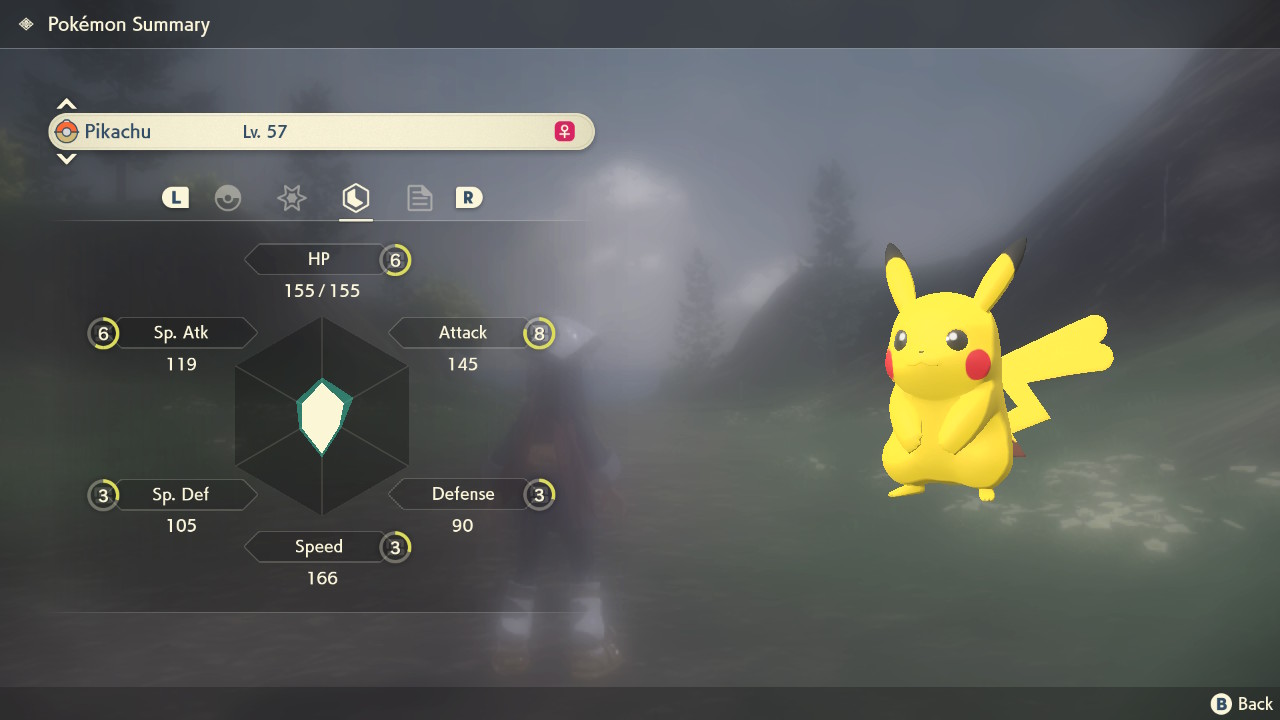
Effort Levels of a trained Pikachu.
Players can raise the Effort Level for a specific stat with Grit items:
- Grit Dust: Raises ELs between 0–3
- Grit Gravel: Raises ELs between 3–6
- Grit Pebble: Raises ELs between 6–9
- Grit Rock: Raises ELs from 9 to 10
Grit Pebbles and Rocks are rare and become available in the game’s later stages. This tier-based system on Grit items ensures players do not max ELs of a Pokémon too early in the game.
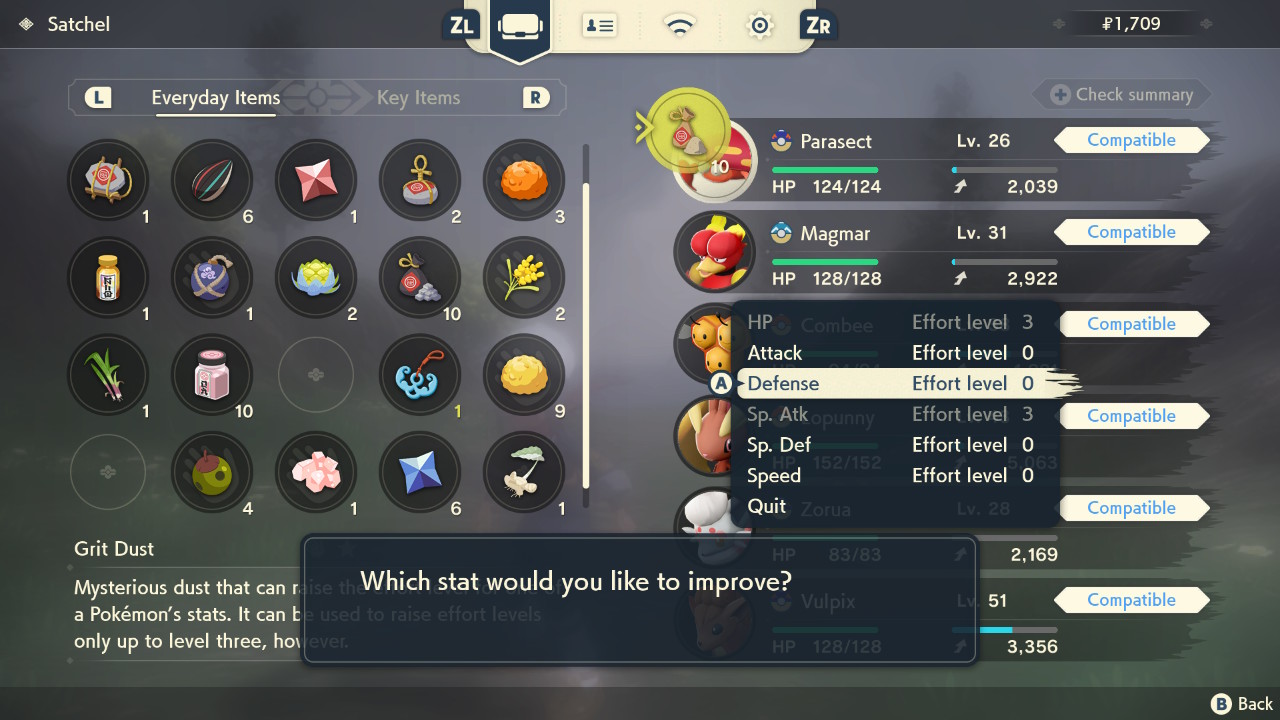
Using Grit Dust.
Effort Levels is a simplified and more straightforward version of the old overly complicated Effort Values. It gives more control over a Pokémon’s development, does a better job explaining itself, and pushes players to explore the world for Grit items.
"Gotta Catch 'Em All!" Problem
Pokédex
In older Pokémon games, players got two objectives from the very start of the game;
- Primary Objective: Become the greatest Pokémon master
- Optional Objective: Complete the Pokédex, also referred to as the Pokémon encyclopedia.
Completing a Pokédex required catching all Pokémon within that game and sometimes from other Pokémon games. An objective that fans have considered to be really difficult since the first Pokémon games in 1996.
In order to make it easier, Game Freak came up with the idea of Regional and National Pokédex in 2002 with Pokémon Ruby & Sapphire.
The Regional Pokédex only required Pokémon to be caught from the game’s regions. On the other hand, National Pokédex required ALL Pokémon, including from other games. They had to be caught and transferred to the player’s current game. Catching them all was still painfully difficult.
In 2016, with the release of Pokémon Sun & Moon, the National Pokédex was removed entirely. It made it a lot easier to finish the Pokédex. Nevertheless, it was not enough since catching every Pokémon and completing a Regional Pokédex still required too much effort for what it was worth.
On top of the difficulty of completing a Pokédex, the rewards for actually pulling it off were trivial. The most popular reward was a “Shiny Charm” that increased the chance of a shiny Pokémon encounter. They were mostly just rare and recolored versions.
Overall, completing a Pokédex remained very difficult and not very rewarding for a long time. Not many people bothered to complete it. Game Freak must have taken the hint because Pokédex in PLA works much differently.
In PLA, filling a Pokédex is no longer an optional task. Filling a large part of it is mandatory. In order to progress in the main story, players need to fill some portion of their Pokédex from time to time. It increases the importance of the Pokédex and makes it more meaningful with a clear goal. However, just catching Pokémon to fill it is NO longer enough.
In addition to catching a Pokémon, players now need to do their Research Tasks to complete their entry into the Pokédex. Completing a Research Task increase that entry’s Research Points. 10 points mean that Pokémon’s entry is complete.
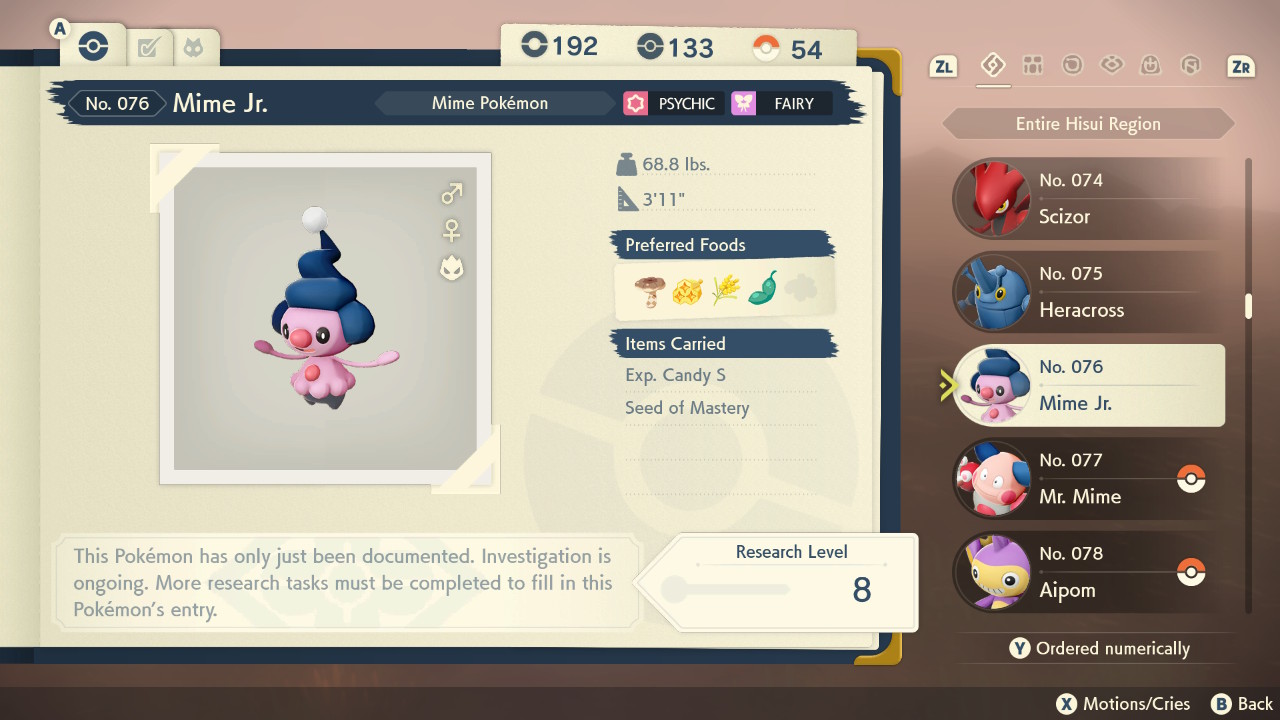
An incomplete Mime Jr. entry within the Pokédex.
Didn’t we establish that catching all of them was already tricky? Now we have to complete additional tasks?
In previous titles, the problem with the Pokédex was not just it being difficult to complete due to the sheer number of Pokémon. The mechanics leading to its completion was also part of the issue.
Fighting and catching Pokémon hundreds of times was a repetitive experience. Players only bothered to catch powerful ones or whatever they fancied the most.
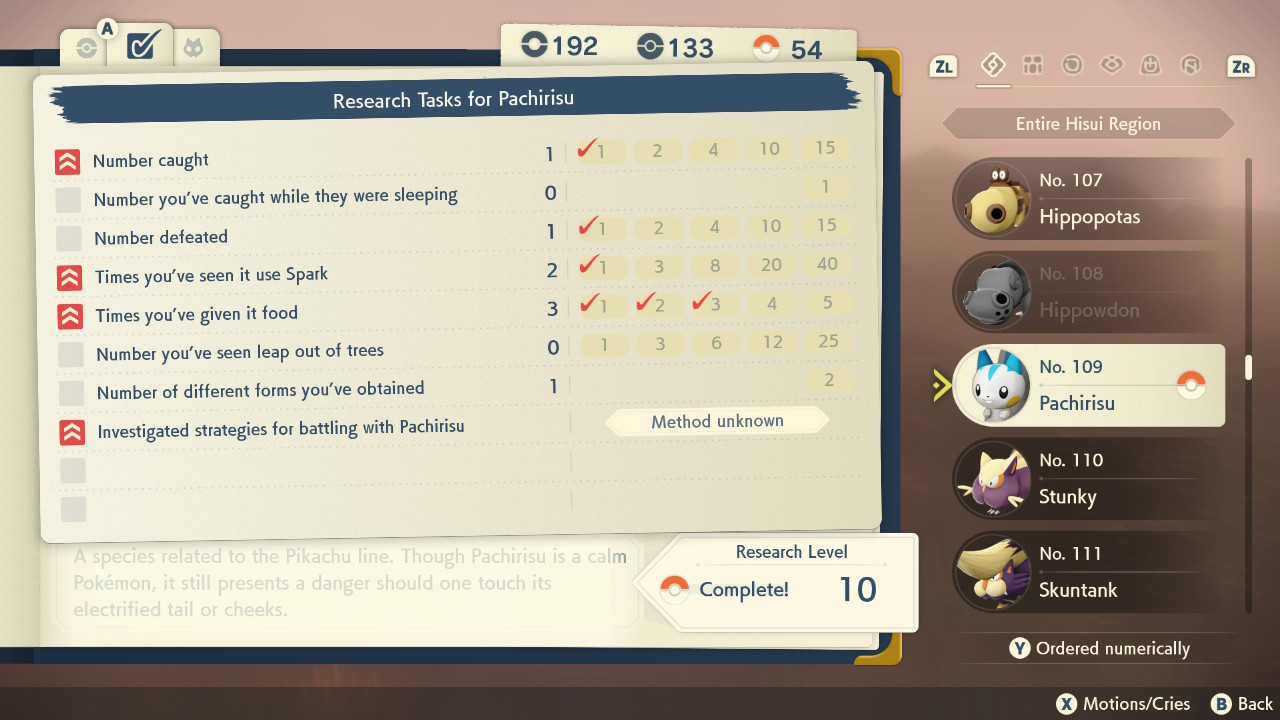
Completed Research Tasks marked with red on the left count as two points.
In PLA, Research Tasks such as seeing them use specific moves or exploiting their weaknesses are fun new additions. Nevertheless, if players were to engage more with the Pokédex, something more fundamental had to be different, the actions of catching Pokémon.
Catching Pokémon & Exploration
The mainline Pokémon series usually used random-chance encounters and systems for players to find Pokémon. Players would travel inside a particular grass or cave area in the world to trigger a battle encounter with a random Pokémon that was available in that area.
These encounters received a makeover in PLA. All wild Pokémon are visible in the world, and they mind their own business in their natural habitats. They move around, sleep, eat and play a couple of idle animations. Seeing them like that also creates a Safari-like experience.
Encountering a Pokémon in PLA does not immediately trigger a battle. Players can throw Poké Balls at Pokémon to try to catch them without fighting. A massive change from the previous titles.
If a player gets too close to a wild Pokémon, it acts differently depending on their species. There are 3 Pokémon personalities: Neutral, Timid, and Aggressive.
- Neutral Pokémon act neutral toward the player and do nothing. They are relatively easy to catch.
- Timid Pokémon run away on sight, so players need to be more strategic and stealthy in their approach. Players can crouch in tall grasses to hide and close in on unsuspecting Pokémon, throw fruit as bait, and hit a Pokémon from behind with a Poké Ball, increasing the chance of it being caught.
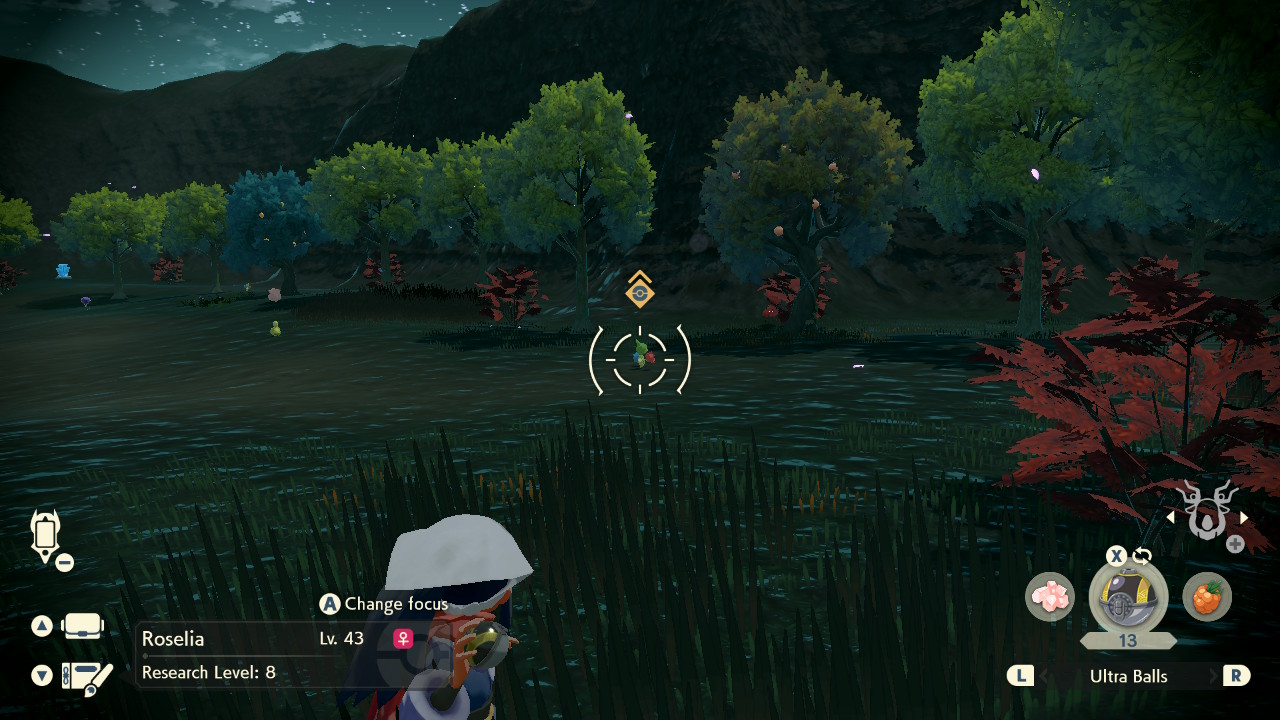
The player is hiding in tall grass and targetting a Roselia.
- Aggressive Pokémon attack and execute various moves when they see the player. Attacks can include fireballs, hypnosis, poisonous powders, rock throws, and so on. Players can roll and dodge them with some good timing.
Players cannot simply catch Aggressive types without initiating a battle with them if the target’s level is high. In order to start a fight with any wild Pokémon, players can throw their Pokémon’s Poké Balls directly at or next to them. Hitting the target from behind will cause the target to be surprised and lose its first turn in battle.
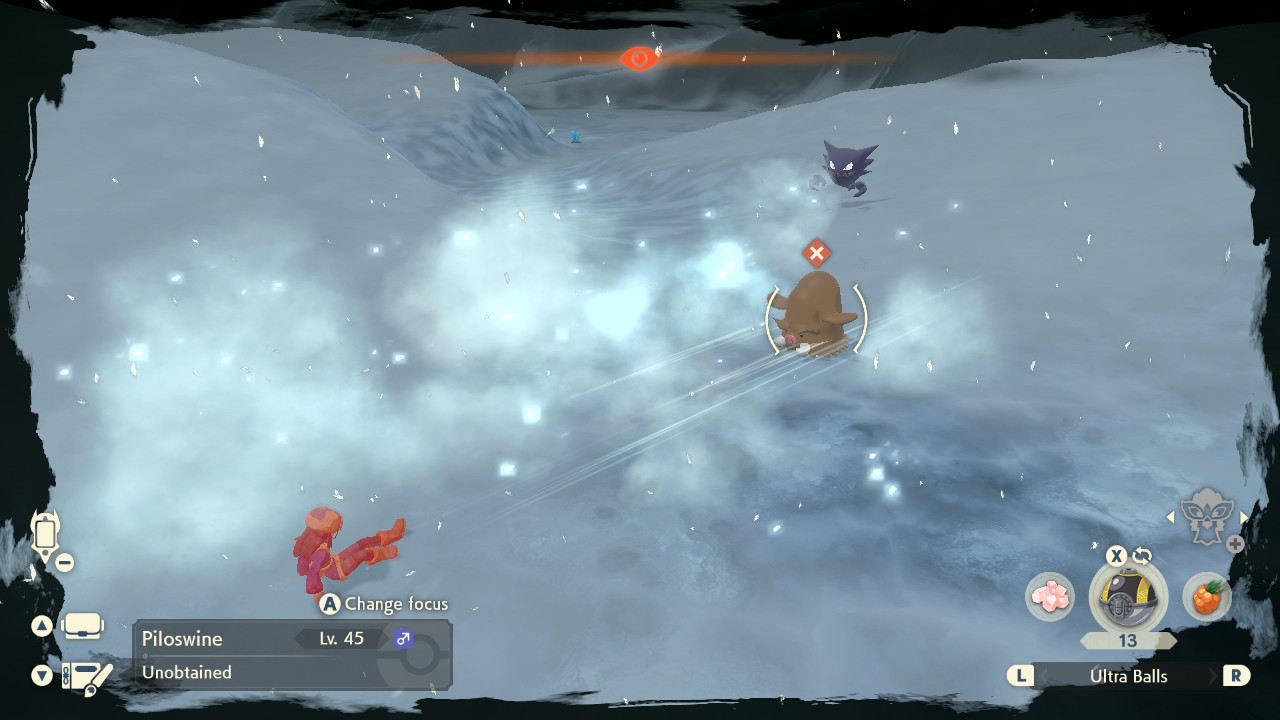
An aggressive Piloswine knocks the player down with Icy Wind.
PLA propels players to get creative while catching Pokémon. Players still have to battle a lot, but it is no longer occurring so often. Different Pokémon behaviors, baiting, and stealth keep the loop of catching them fresh and engaging.
Variety within catching methods reduces repetition and makes completing the Pokédex fun and accessible. As a result, grinding is both flexible and innovative, a trait the last 25 years of the Pokémon mainline series did not quite deliver.
Optimal & Meaningful Challenge
Scaling
A minor issue the previous Pokémon titles had was that battles were becoming easy too quickly.
Wild Pokémon did not scale with the progress and power of the player’s team. Players seldomly lost a fight and got all of their Pokémon knocked out.
Various regions throughout the story spawned Pokémon with levels from defined ranges. If a player went back to a previously completed region, the player’s team would usually steamroll any opposing wild Pokémon.
PLA introduces two new concepts to tackle the difficulty issue. Effort Level Scaling and Alpha Pokémon.
In PLA, Effort Levels of Wild Pokémon scale with the player’s progress and power. The same level 5 Pikachu in the early-game phase hits a lot harder when the players are about to approach the end of the game. Backtracking or exploring previous regions is no longer a cakewalk.
Alpha Type
Alpha Pokémon are rare, aggressive, bigger, stronger, and harder to catch than the average Wild Pokémon. They can use Agile and Strong styles, have high Effort Levels, and usually know a move that cannot be learned by leveling up.
They spawn with really high levels, and the first starting region may even have one up to level 65. Players are encouraged to avoid them and try to catch them when their team is much stronger.
Catching an Alpha Pokémon is like a mini-boss experience and is often quite challenging. They motivate players to backtrack and explore. They also help completed regions scale with the player’s progress.
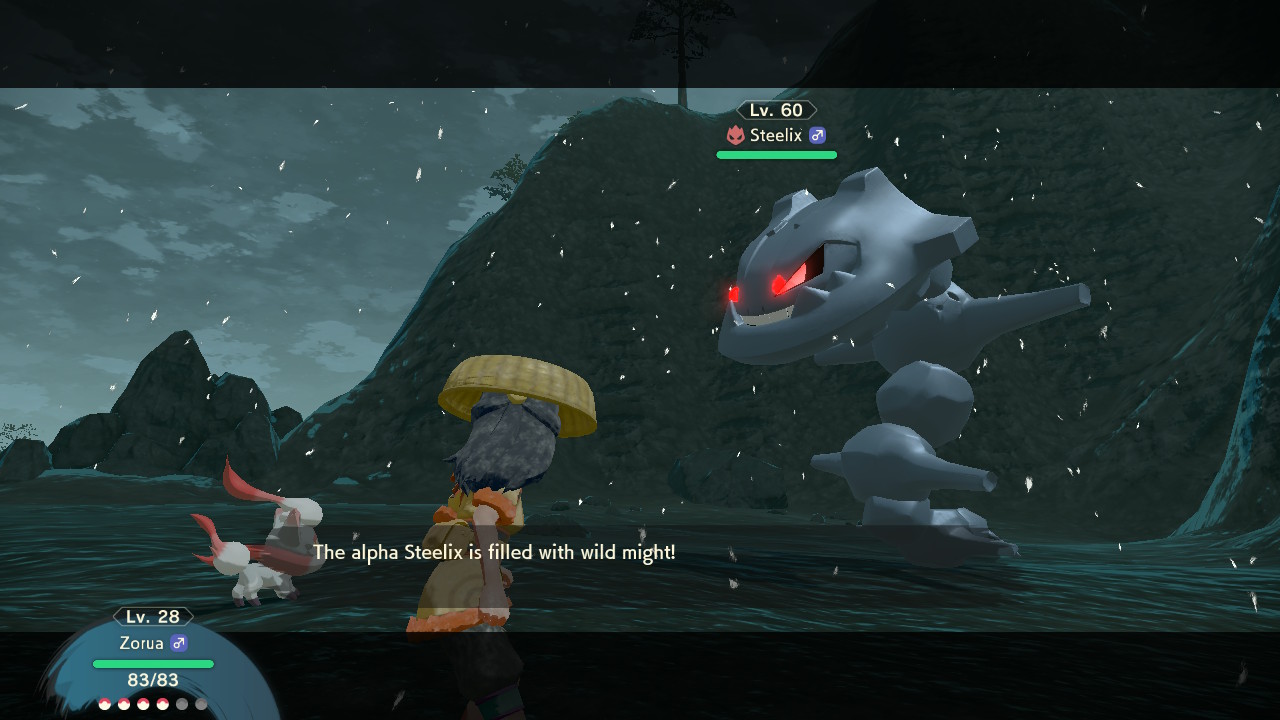
An Alpha Pokémon battle.
It should be noted that Pokémon games never aim to be very difficult. Their target audience is mostly very young. PLA provides enough obstacles that players’ whole Pokémon party may get knocked out a few times. After all, players thrive when they are optimally challenged. Even if the players’ whole party faints, they can still run away safely. Players are no longer defeated if they run out of Pokémon to send out.
Semi-Open World
Tools of Exploration
Previous Pokémon titles had Pokemon moves that were also usable outside of battles, such as Cut, Fly, Swim, or Teleport. Pokémon Sun and Moon also introduced rideable Pokémon in the past.
Pokémon Legends: Arceus has a few travel and exploration abilities available as well. They are similar to the ones in The Legend of Zelda: Breath of the Wild, such as riding, gliding, swimming, and climbing. These abilities are only possible with the help of various Pokémon, which unlock as players progress in the story.
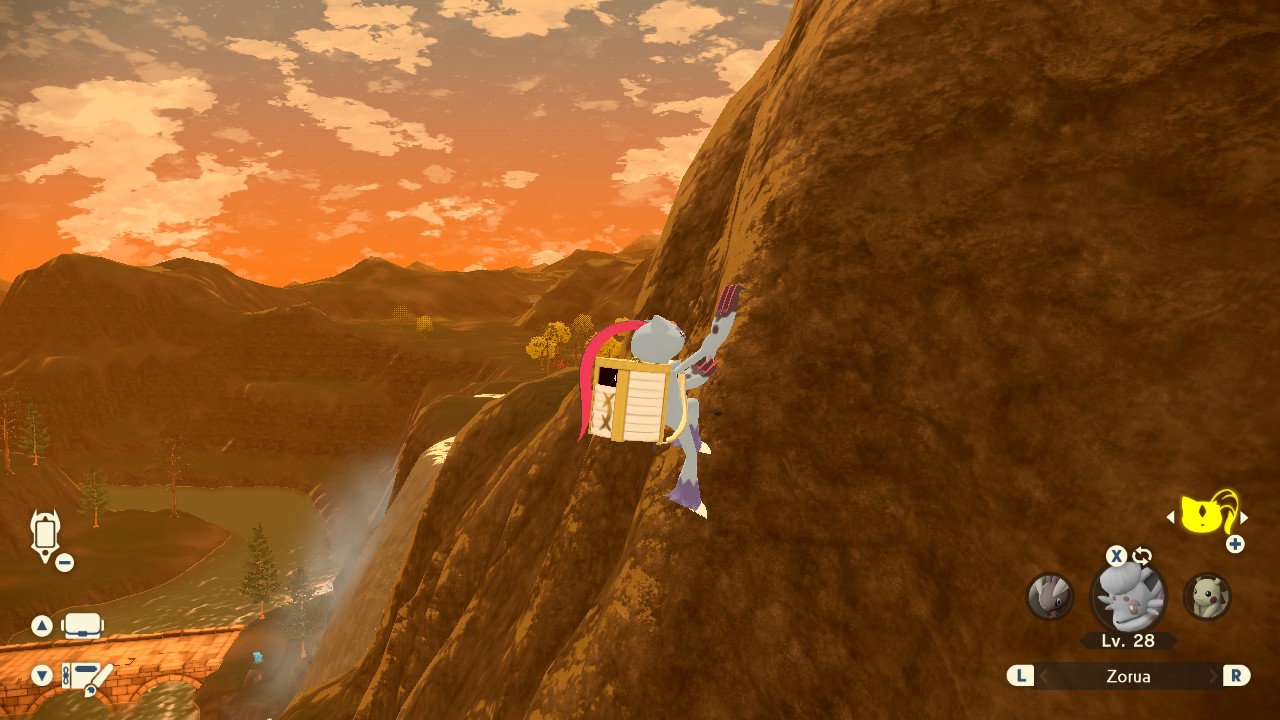
The player controlling a Sneasler to climb a mountain.
Central Hub & Camps
PLA is not precisely Open-World, and it follows a more Monster Hunter-like structure where players have a central hub (village) to which they need to go back frequently and prepare for the next mission. Players cannot travel from region to region without stopping at the village first. In addition to the village, there are small camps in every region which players can fast travel to and get some healing or simple shopping done.
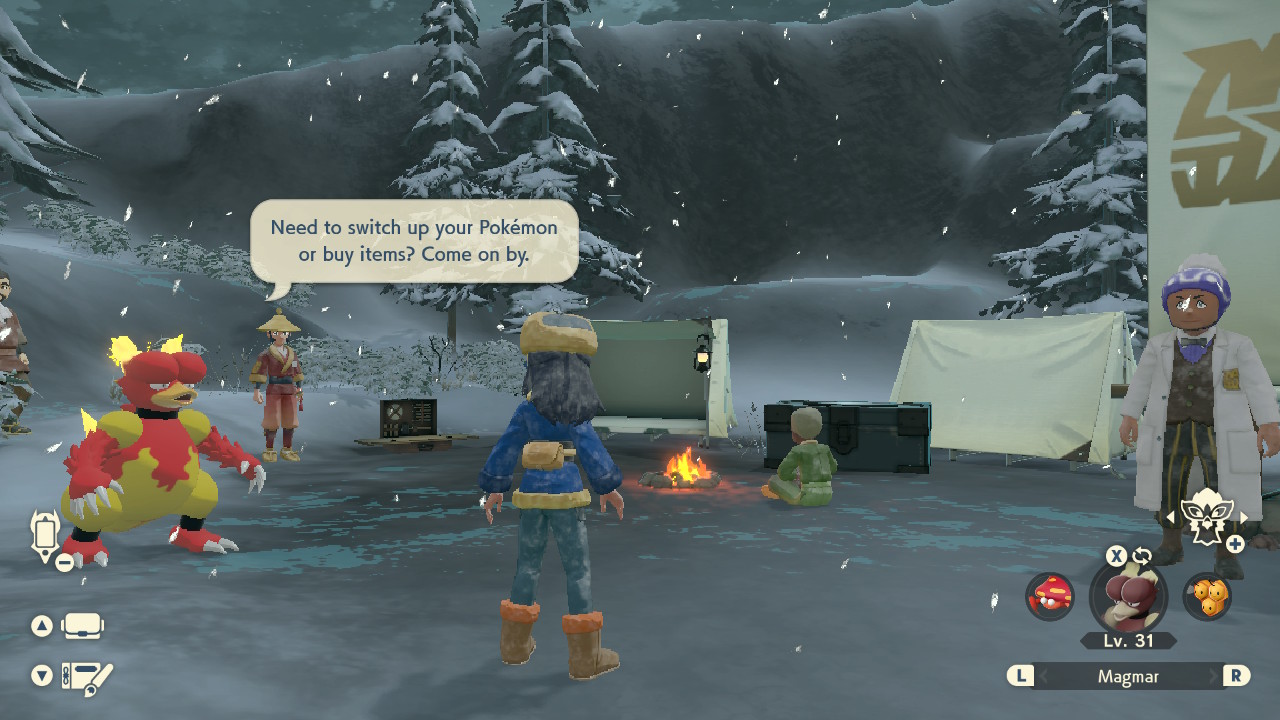
The player in a friendly campsite.
Older Pokémon games did not have such strict restrictions on fast travel. However, it is understandable why Game Freak chose the central hub approach to make the village stand out more.
The village thrives in parallel to how many quests the player completes. Village folk gets friendlier with Pokemon, and various shops receive upgrades. More visits to the village (central hub) give the player a better sense of progression.
Personal Thoughts
Game Freak has absolutely outdone themselves. They identified the problems the previous mainline Pokémon titles shared and found excellent solutions to them within PLA. The weak visuals of the game have been mostly criticized, but it did not stop me from having a great gameplay experience.
I do not think I would be exaggerating if I said Pokémon Legends: Arceus is the best Pokémon game I have experienced so far.