Important Ingredients of Hades
22 Nov 2020
I believe 4 important ingredients make Hades shine through its roguelike brethren and reach out to the hearts of many players.
After staying in the early access since December 2018, Hades has finally been fully released in September 2020. It has sold 700,000 copies during early access, within 3 days of its release it sold an additional 300,000 copies. Received lots of rewards, praise, excellent reviews and has been in the weekly global top 10 sellers on Steam for a few months. What makes Hades an exceptionally good roguelike?
1) Lessons from Previous Titles
Bastion's Camp

Player's "home" from Bastion and Hades.
Similar to Bastion, Hades also features a personal-HQ where players get to upgrade or customize with each run. In short, a “home” where players get to track their progress, achievements, and collections.
Bastion provides players with the goal of reviving and rebuilding a sanctuary. Players can construct buildings on it that are needed to overcome obstacles ahead. These buildings provide the player with the ability to gear up with various weapons, skills, and potions. Some characters met within the story also gathered in the rebuilt sanctuary, which added some optional extra story bits. Bastion’s sanctuary serves as a personalized safe hub that grows in parallel to players’ progress.
Hades takes this same concept with a lighter construction side and makes it so that every time the players come back, there is always something new to uncover and look forward to. This customizable utility and trophy HQ helps players become emotionally attached while providing utmost satisfaction for their progress.
More Clear UX, Less Transistor
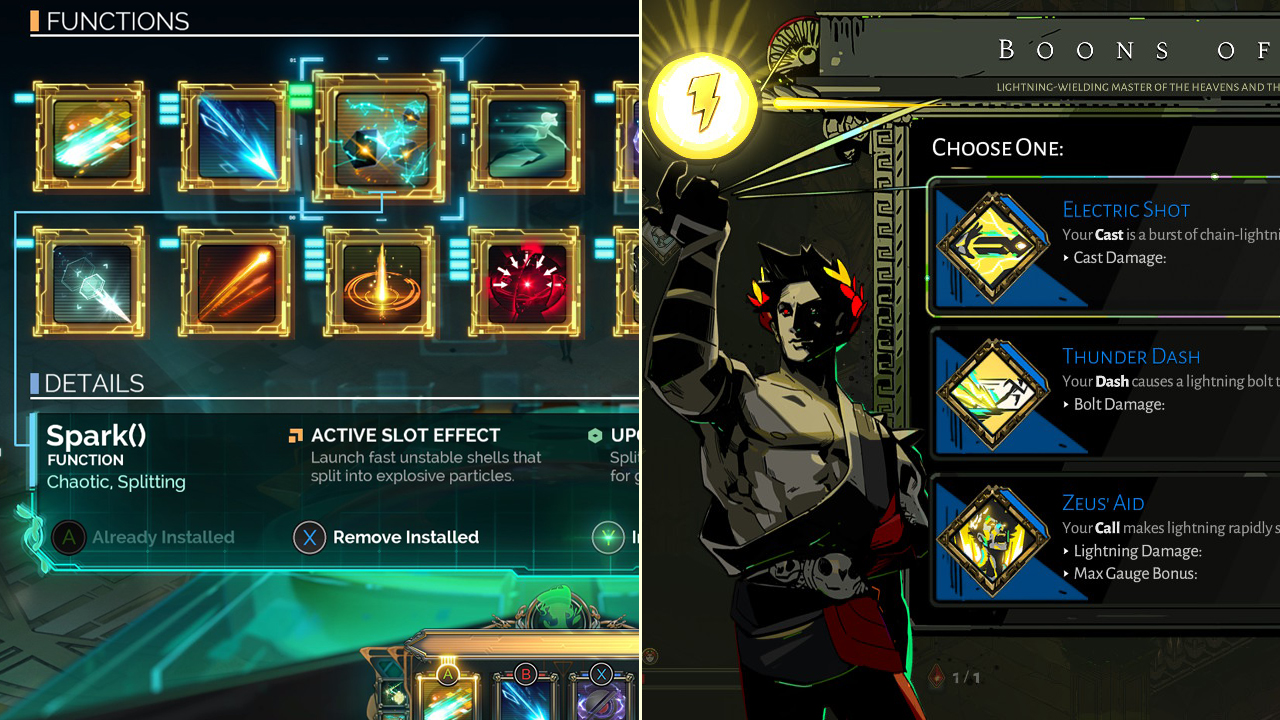
Powers from Transistor and Hades.
Gameplay mechanics are clear and easier to understand in Hades. Powers and combat don’t make players pause and think, unlike Transistor’s somewhat needlessly complex skill structure. This may sound trivial but I believe it helps players stay in their “flow” and keeps the game immersive with fewer distractions.
For instance, abilities in Transistor are described as Functions implemented inside the player’s weapon and named as such. To name a few: “Get()”, “Jaunt()”” and “Bounce()”. These functions yield different effects under which slot they are installed in. They feel slightly inaccessible and do not communicate clearly.
Hades takes a more direct approach. Even with a glance, players can guess what an ability might be about. It doesn’t take a lot of effort to understand that an ability called “Electric Shot” can be an electric-based attack. They are more to the point with short descriptions.
Pyre's Branching Stories

Each path tells a different story in Pyre.
“Man, we did all that work to create truly branching open-ended storytelling, but Pyre feels like a game that you’d only play once,” says Greg Kasavin from Supergiant. Pyre included a deep branching story system where players were able to choose their paths and customize their narrative experience. Design lessons from Pyre helped their team realize roguelikes may be a much better fit for non-linear, and player-driven storytelling.
That is not to say that it was a wrong choice for Pyre, it was just a better fit for Hades. Giving players the ability to shape the story with their own choices often makes games a joy to get lost in. With Hades’ quicker replayability branching stories can be explored at a much faster rate improving the interactive storytelling and overall experience.
2) Reactive and Progressing Story

Each character has unique reactions to player's actions.
Compared to Bastion and Transistor, Hades responds to player actions in much more detail. As a result, makes each run memorable and unique. Each character has a wide variety of responses to different situations brought by the player. Every run and death unlocks more bits of the story, dying becomes a tool of storytelling. Games reacting narratively to player progression isn’t entirely new but I believe it hasn’t been executed as well as in Hades. It is a bit hard to describe, it isn’t like just as if some NPC is reading the player a monologue for finishing a quest or meeting a requirement. The story and characters build up at such a pace in Hades that all the reactions of characters feel natural.
3) Dying is Fun
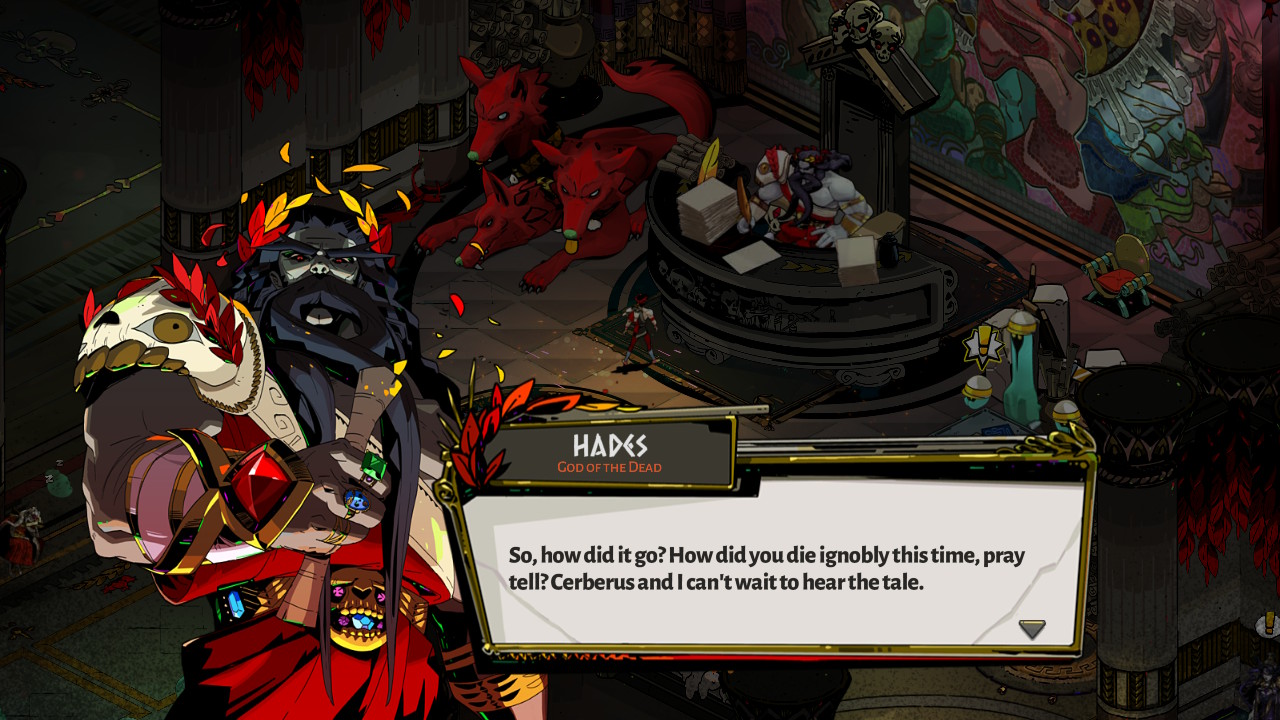
“It was an explicit goal of our early development, to take the pain out of dying and having to restart,” - Greg Kasavin.
Dying and then restarting a run in the underworld of Hades feels like it is a part of the story. Players fail and die, spawn back to life from a pool of blood back at the start zone, the bad-dad Hades makes fun of them, a bit more of the story unfolds with new toys for players to experiment with and new characters to meet. Unlike many other roguelikes, failing in Hades feels a lot less painless and even exciting to some degree because players get to experience fresh new content immensely enhanced by the game’s excellent theme and backdrop.

Zagreus often makes fun remarks to his deaths.
Setting up players for failure is paramount in roguelikes. The power progression should exponentially grow up until that point that it should feel alright to let go. The ability to keep some of the gear and upgrades after dying also helps failure become something expected. Hades, in addition to its in-session power progression also has a well-designed out-of-session one which has been masterfully integrated with reactive storytelling. In each run players can collect resources that can be used to purchase permanent upgrades for their underworld-run and character. Unlockables that can be carried from a run attempt to another makes dying even less troubling, all the new narrative that will come with these tools makes it even more exciting. These elements have been implemented so well in the game that dying in Hades is almost a welcoming experience.
4) Early Access and Narration

Demeter, a character who has been added during early access development.
Like many other early access games, Hades’ team adopted a development route in partnership with the community and their feedback. They have set up monthly milestones for their features and met their deadlines with disciplined planning. While many of the key features were already complete by the launch of early access, the story, however, was not. This helped their team shape and polish the game not just from a game-design perspective but from a narrative one as well. It seems like it paid off extremely well. Players who haven’t been captivated by Hades’ polished storytelling is pretty rare.

Gods are fickle in Hades. Earning the favor of one can result in experiencing the wrath of another.
Of course, other features also contribute to Hades’ success, such as the smooth combat systems, unlockable weapons, bonuses for completing runs with unused items, “aspect” system, gifting characters, Jen Zee’s art style, the combination of powers, and much more. However, tackling all that would make this a pretty lengthy post. I also personally just wanted to briefly talk about the points which I found exceptionally well executed and placed Hades where it is today. If you haven’t tried Hades already, give this fresh and beautiful roguelike a chance.